
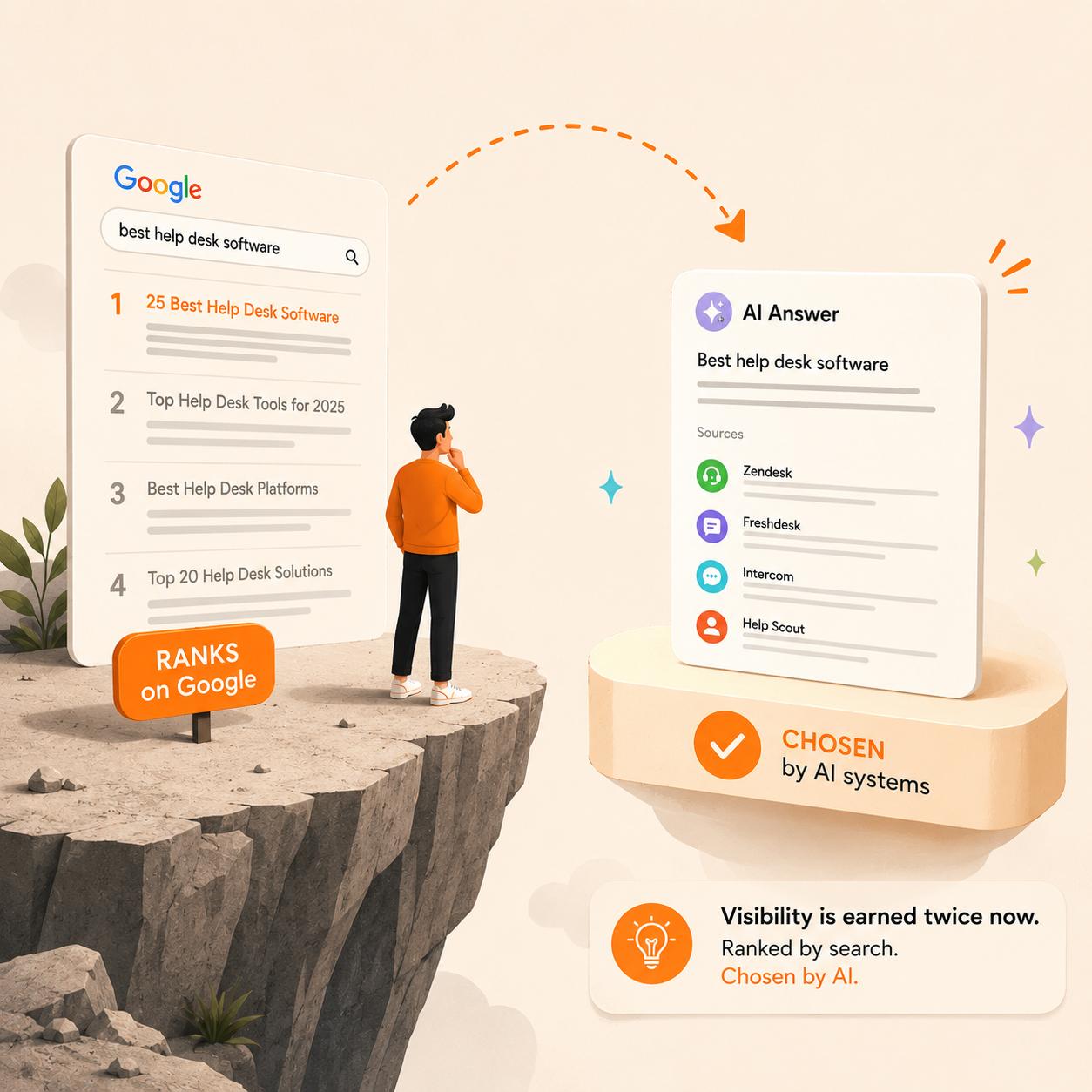
Search for “best help desk software” on Google, and you will see the same pattern that has defined SEO for years. Long listicles dominate the page. Big brands like Zendesk and HubSpot show up consistently. Many of these pages rank because they are well-optimized, frequently updated, and built to cover as many tools as possible in one place.
Now ask the same question in Perplexity AI. The answer changes immediately.
Instead of listing twenty tools, it narrows the field. You will typically see a smaller set that includes products like Zendesk, Freshdesk, Intercom, or Help Scout. More importantly, the sources it cites are not always the same pages that rank on Google. In several cases, well-ranking aggregator listicles are skipped entirely, while more focused pages that clearly explain a specific use case are pulled in instead.
Run the same query through ChatGPT, and you will see the same behavior. The response is direct, selective, and built from a handful of inputs. It does not attempt to replicate the search results page, and it does not try to include every option that exists.
This is where the shift becomes hard to ignore.
Pages that rank are not guaranteed to be used. Some of them are not even considered. The underlying system has changed. These tools are not trying to show the best-ranked content. They are making a judgment call on which sources are clear enough, reliable enough, and usable enough to construct an answer.
And once you see that, it becomes clear that visibility is no longer just about ranking.
Why the Same Query Shows Completely Different Results on Google vs AI Tools
Take that same query: “best help desk software.”
On Google, the results follow a familiar pattern. You’ll see long listicles from companies like Zendesk or HubSpot, along with aggregator blogs that have been competing for this keyword for years. Most of these pages look different at first glance, but once you read a few, the structure is almost identical. A long intro, a list of 15 to 25 tools, and a templated breakdown for each one.
Now run that same query through Perplexity AI.
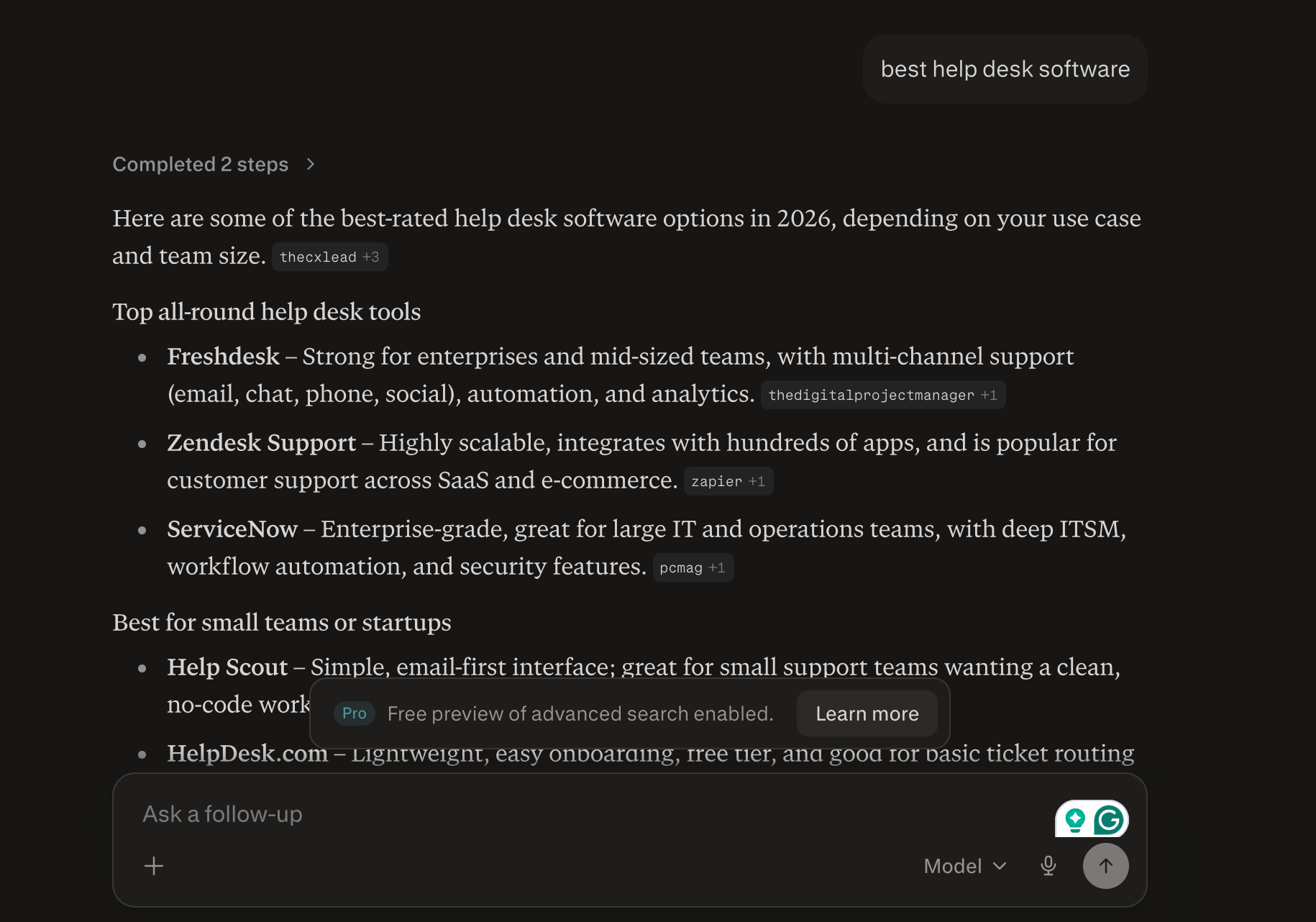
The difference is immediate. The answer is shorter, more selective, and doesn’t try to cover everything. Instead of listing every possible tool, it focuses on a handful. It pulls from sources that are easier to quote, easier to summarize, and easier to trust. Some of those sources are familiar, but many aren’t the same pages that dominate Google.
Ask ChatGPT, and you’ll see a similar pattern. The answer is more direct, the structure is cleaner, and only a small number of references actually make it into the final response.
This is where things start to click.
These systems aren’t trying to recreate search results. They’re making a call on which sources are clear enough, reliable enough, and usable enough to form an answer.
And once you look at it that way, the gap becomes hard to ignore.
Ranking on Google doesn’t automatically mean you’ll be used. In a lot of cases, it doesn’t even mean you’ll be considered.
AI Systems Select and Use Content (And Most Content Fails That Filter)
Once you start noticing this pattern, the next question is obvious. Why are these systems picking different sources in the first place?
The answer is simpler than most people expect. They’re not trying to rank content. They’re trying to use it. And once you see how that process works, the difference becomes obvious.
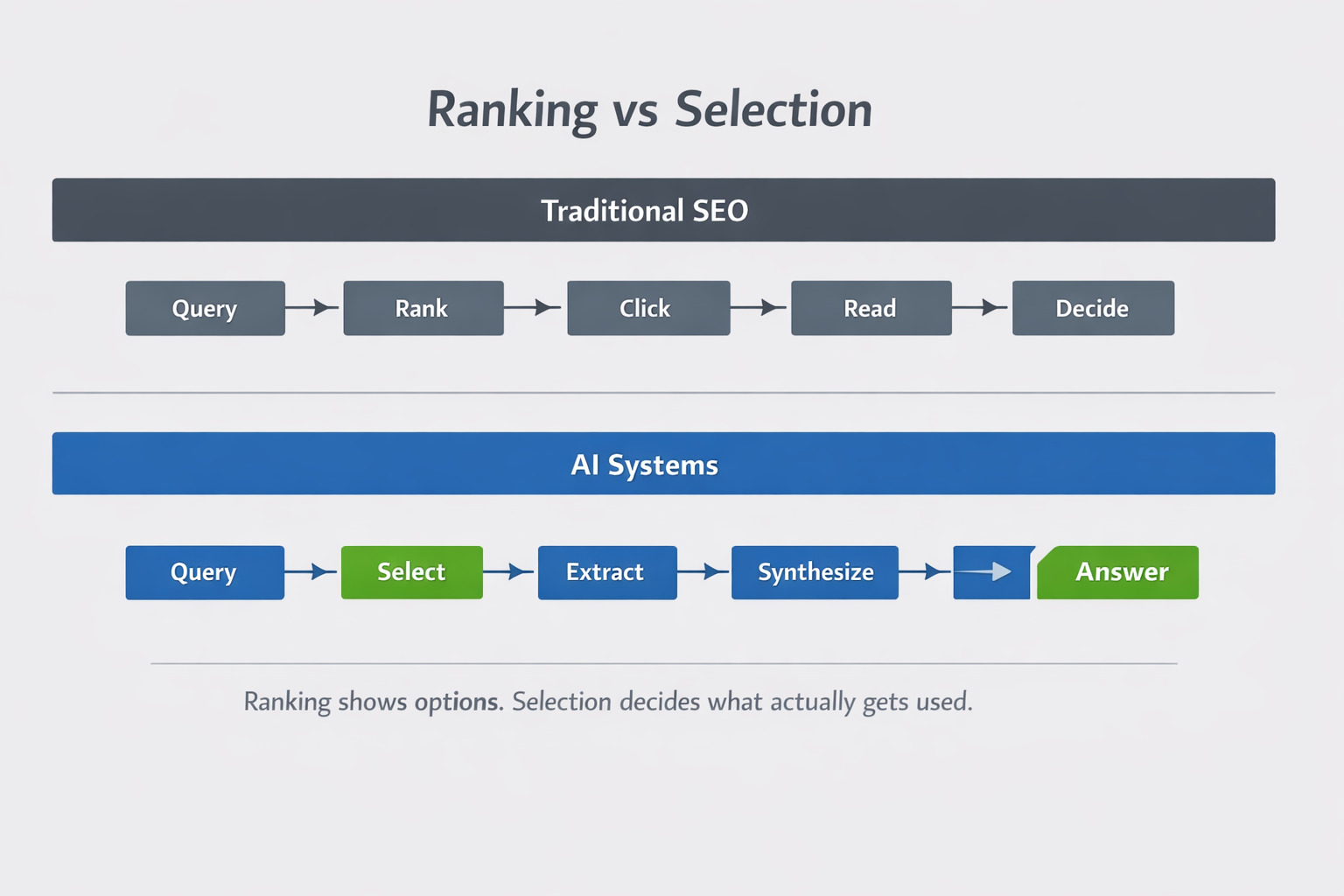
That changes the rules completely.
A typical SEO page is built to perform well on search. It’s designed to cover a keyword thoroughly, include variations, add internal links, and keep the reader scrolling. It’s optimized to signal relevance.
But that’s not what an AI system needs.
When tools like ChatGPT or Perplexity AI generate a response, they’re doing something much more constrained. They’re pulling in small pieces of information and stitching them together into a single answer. So they naturally favor content that is:
- Easy to extract
- Clear enough to quote without rewriting
- Specific enough to stand on its own
And this is where most content quietly breaks.
A lot of high-ranking pages are long, padded, and built to cover everything. They take time to get to the point. They rely on structure, that works for scanning, not for extraction. And they often avoid taking a strong stance, which makes them harder to trust in isolation.
From an SEO perspective, that works. From an AI perspective, it creates friction.
If a system has to interpret, rewrite, or second-guess what you’re saying, it’s more likely to move on to a source that’s easier to use.
That’s why you’re seeing smaller, more focused pages get picked over larger, better-ranked ones. Not because they’re more authoritative, but because they’re more usable.
This is also why a lot of “perfectly optimized” content doesn’t show up at all. It was never written to be used this way.
Will Your Content Be Used by AI Systems at All?
Once you look at content through this lens, it becomes pretty obvious that we’ve been optimizing for the wrong outcome.
- We’ve been asking: “Will this rank?”
- The better question now is: “Will this be used?”
That’s really what I mean by AI Indexing Score.
Not a metric you’ll find in a dashboard. More like a filter you apply to your own content.
If you had to guess, honestly, would a system like ChatGPT or Perplexity AI pick this page as a source?
Most content doesn’t pass that test.
Not because it’s bad, but because it’s doing something else. It’s trying to be comprehensive, SEO-friendly, and conversion-focused all at once. And in the process, it becomes harder to extract, harder to quote, and harder to trust in isolation.
Once you start thinking this way, a few patterns stand out pretty quickly.
Content that gets used tends to say things clearly and early. It doesn’t take 800 words to get to a point. It doesn’t rely on generic phrasing. It actually answers the question in a way that can be lifted and reused.
It also tends to have a point of view. Not extreme, but clear enough that a system can confidently include it without having to reinterpret what the author meant.
And most importantly, it feels complete even in small pieces. If you pull out a paragraph or a section, it still makes sense on its own.
That’s very different from how a lot of SEO content is written today.
This doesn’t mean SEO stops mattering. It just means it’s no longer the final step. Ranking might get you into consideration, but it doesn’t guarantee you’ll be part of the answer.
And that’s the shift most teams haven’t fully internalized yet.
Why Most SEO Content Is Structured Wrong for AI (And What Needs to Change)
If this shift is real, and at this point it’s hard to argue that it isn’t, then the way most teams approach content needs to change pretty quickly.
Not completely. But in a very specific way.
What’s really helped me think about this is flipping the order of how content is usually written.
Most SEO pages are built like this: start broad, add context, build up the topic, and then eventually get to the answer.
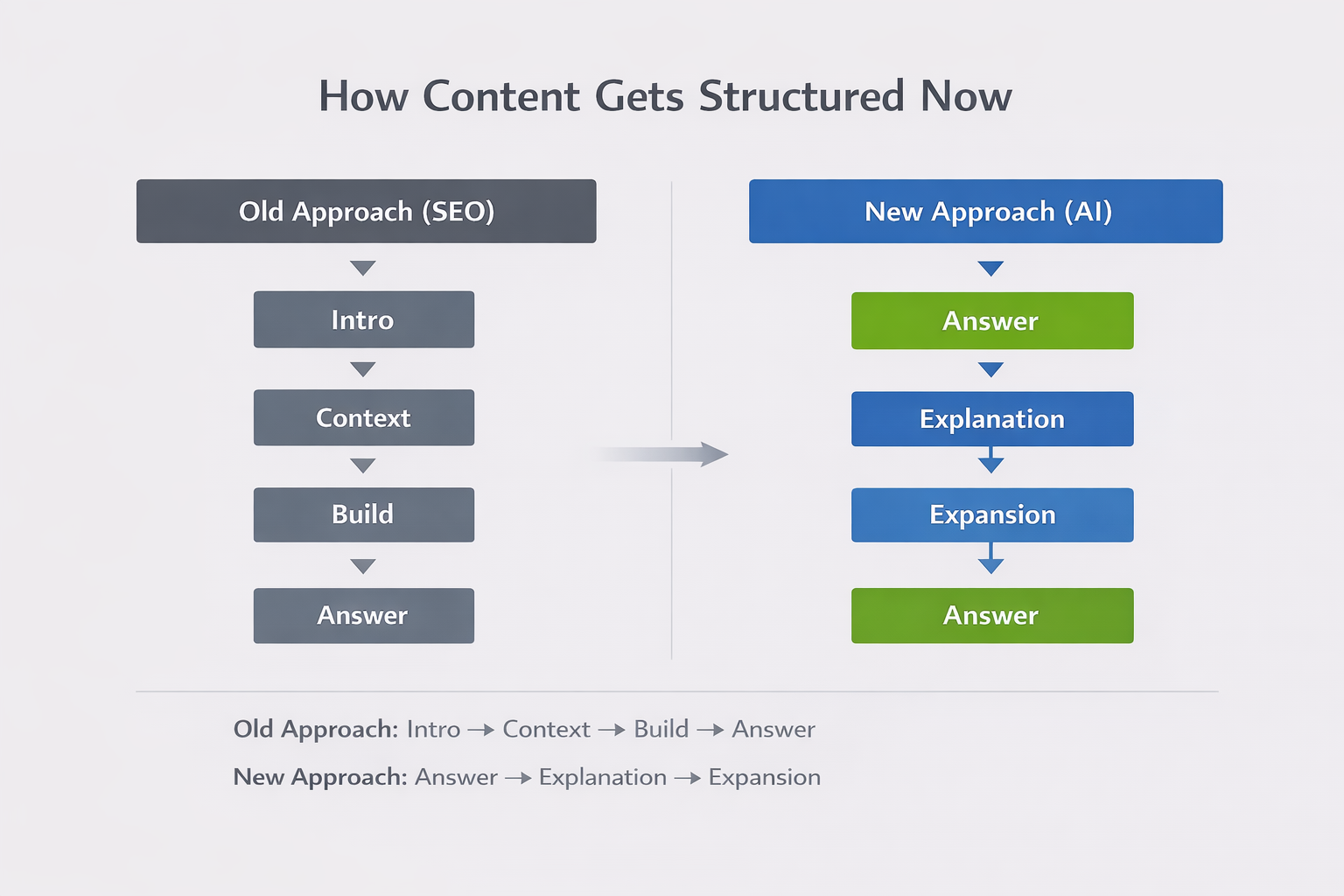
That works when the goal is to keep someone on the page. It doesn’t work when the goal is to be used inside an answer.
Now the pressure is different. You have to make your point early, make it clearly, and make it in a way that can stand on its own. If the most useful part of your page is buried halfway down, there’s a good chance it never gets picked up at all.
The same thing applies to how we write about tools, comparisons, or recommendations.
A lot of listicles try to cover everything and stay neutral. They describe each option in roughly the same way and avoid saying anything too specific. It feels “safe,” but it also makes every section interchangeable.
From an AI perspective, that’s not very helpful.
What gets picked more often is content that makes a clear call. Something that explains why one option works better in a specific context, or where something falls short. It gives the system something concrete to use instead of something it has to interpret.
You also start to notice how much unnecessary weight most pages carry.
Long intros, repeated transitions, filler explanations that don’t really add anything. They make the page feel complete, but they don’t actually make it more usable. In a lot of cases, they do the opposite.
What tends to work better is content that feels tighter. Not shorter for the sake of it, but more direct. Every section earns its place. Every paragraph adds something specific.
And then there’s structure.
Most SEO content is structured for scanning. Headings, bullet points, summaries. That still matters, but now there’s an added layer. Can a single section be lifted out and still make sense? Can a paragraph be quoted without needing the rest of the page to explain it?
That’s the bar. None of this is complicated. But it is different from how most content is being produced today.
And the gap between those two approaches is exactly where visibility is starting to shift.
SEO Still Gets You Traffic. AI Decides If You Get Used
SEO hasn’t gone away. But it’s no longer the system that decides what gets used.
You can still rank. You can still drive traffic. But if your content isn’t being picked up by systems like ChatGPT or Perplexity AI, a growing portion of your audience will never see it.
That’s the part that’s easy to underestimate. Because nothing breaks overnight. Rankings don’t suddenly disappear. Traffic doesn’t drop to zero. It just starts to matter a little less than it used to.
And over time, that compounds. The teams that adapt will start writing content that answers clearly, takes a position, and is easy to reuse. Not because it’s a new “best practice,” but because that’s what the system now rewards.
Everyone else will keep optimizing for rankings and wondering why their content isn’t showing up where decisions are actually being made.
At that point, it’s more of a relevance problem than visibility problem.