
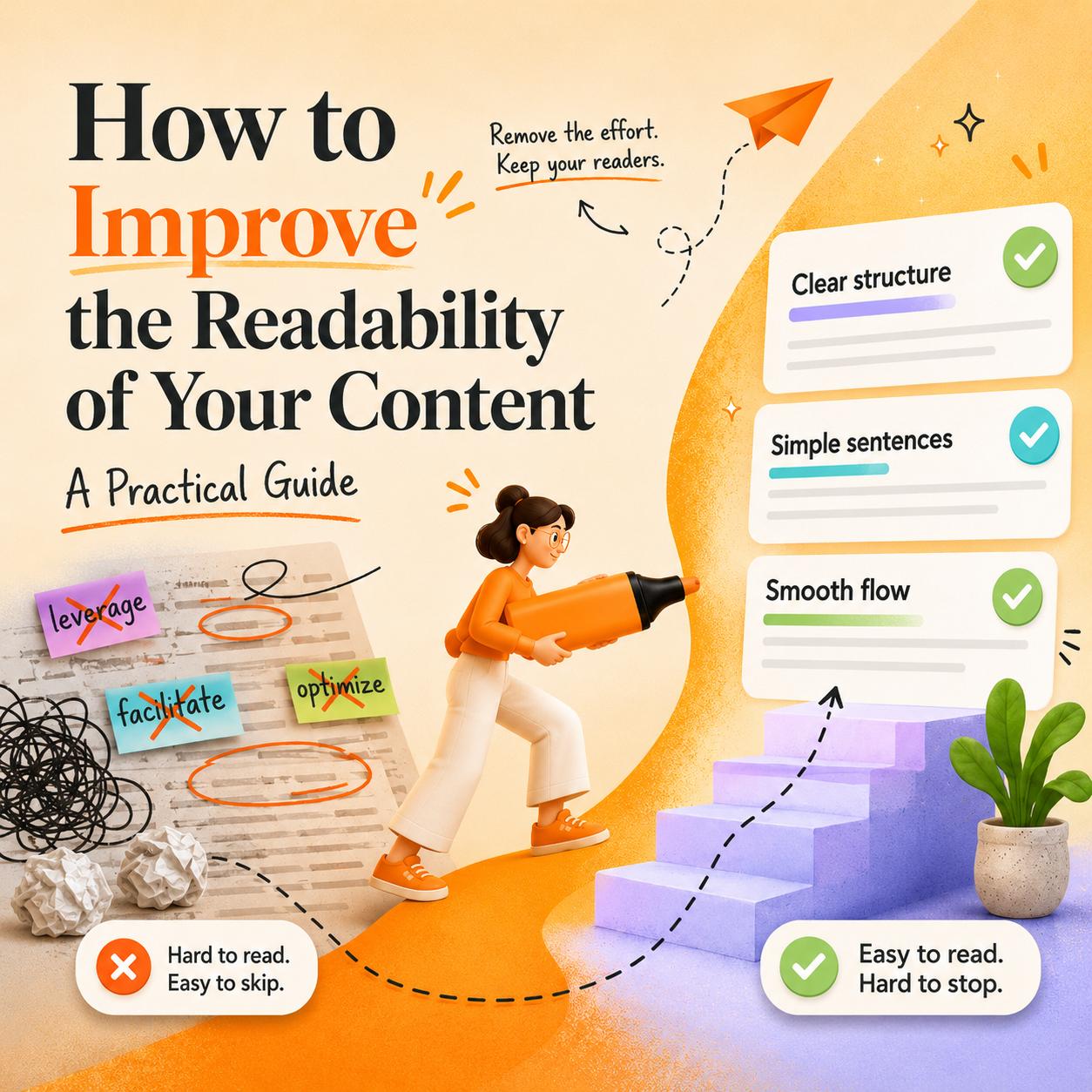
I’ve written content that looked solid on paper but didn't read the way I expected. The ideas were clear, the structure seemed fine, and nothing felt obviously wrong while writing it. Still, people skimmed it, dropped off early, or missed the point.
When I went back and read it honestly, the issue wasn’t clarity but the effort.
The content made sense, but it didn’t flow. I had to slow down, re-read lines, and connect ideas myself. If I felt that, a new reader definitely would.
That’s usually the problem.
You lose readers because it takes too much effort to get through. Improving readability is about removing that effort.
Why your content feels hard to read (even when it’s “well written”)
Most readability advice focuses on the surface. Shorter sentences. Simpler words. Clean formatting.
That’s not where things usually break.
Content becomes hard to read when the reader has to do extra work to follow your thinking. They pause to process a sentence, re-read a line to be sure, or try to understand why one idea comes after another. Nothing is technically wrong, but the experience isn’t smooth.
That friction adds up quickly. You’ll notice it if you read your own content without context. The places where you slow down are the same places your reader will.
I used to write sentences like this:
Our platform is designed to facilitate improved collaboration outcomes across teams by leveraging automation.
It sounds complete, but it makes the reader unpack too much at once.
Now I’d write:
Our platform helps teams collaborate better by automating repetitive work.
The meaning hasn’t changed but the effort has.
That’s the difference. Readability makes it easier to move through without stopping.
Start with one clear outcome (or your content will feel scattered)
Most of my readability problems come from not being clear on what I was trying to help the reader do.
I would start writing with a general idea in mind, add everything that felt “useful,” and end up with a piece that covered the topic but didn’t really go anywhere. It read fine, but it felt scattered because there was no single direction holding it together.
Now I force this before I write anything:
After reading this, the reader should be able to ______.
For this piece, it’s simple:
After reading this, you should be able to make your content easier to read without guessing what to fix.
That one line changes how you write.
You stop adding things just because they sound relevant. You start asking, “does this actually help the reader get there?” If it doesn’t, you cut it.
That’s when content starts to feel tighter. The flow improves, and you don’t lose the reader halfway because every section is clearly moving them toward something.
Fix structure before fixing sentences (this is where most readability improves)
I wasted a lot of time rewriting sentences that were never the real problem.
The content still felt heavy, and I couldn’t figure out why. Then I started changing the structure instead of the wording, and the difference was immediate.
If your structure is off, better sentences won’t save you.
When ideas are stacked without a clear order, the reader has to figure out what matters, what connects, and what to focus on. That’s where they start slowing down.
Now I fix the structure first.
I make sure each section does one job. If a section tries to explain multiple things, I split it. If two sections feel similar, I merge or remove one. And before I move on, I ask a simple question: Does this feel like the next logical step?
Most of the time, it doesn’t go on the first pass. Once the structure is right, sentence-level edits become easy. But if you skip this step, you’ll keep polishing lines inside a piece that still feels hard to read.
Rewrite sentences to reduce effort (this is where most writing feels heavy)
I used to write like I was trying to sound complete. Every sentence had to explain everything clearly, cover all angles, and feel polished. It looked good, but it slowed everything down.
Now I write to land the point as quickly as possible. That usually means cutting more than rewriting. For example, I used to write lines like:
It is important to ensure that your content is written in a way that makes it easy for readers to understand.
Now I’d write:
Your content should be easy to understand.
Nothing important was lost. It just got faster. The same thing happens with long sentences. If a line makes you pause even slightly, it’s doing too much.
When content is written in a way that is not optimized for readability, it can often lead to confusion among readers…
Becomes:
Hard-to-read content confuses readers. They miss key points or stop reading.
You’re not simplifying the idea. You’re removing the delay. That’s the shift. Write so the reader doesn’t have to slow down to keep up.
Use words that don’t slow the reader down
I used to default to words that sounded more “professional.” It made the writing feel polished, but it also made it harder to read.
Words like leverage, utilize, facilitate, and optimize don’t add clarity. They add a small delay because the reader has to translate them. That delay breaks flows.
Now I choose the most direct version of what I’m trying to say, even if it feels too simple at first.
We aim to leverage automation to facilitate improved workflows.
Becomes:
We use automation to improve workflows.
Nothing is lost. It just lands faster.
A quick way I catch this is by asking: would I actually say this out loud? If the answer is no, I rewrite it. You’re not trying to sound smarter. You’re trying to make sure nothing gets in the way of understanding.
Fix how your ideas connect (this is where most content breaks)
This is where most content breaks, and it took me a while to see it. I used to focus on making each section clear. The problem was, I wasn’t paying attention to how those sections connected. So the content felt disjointed, even when each part was well written.
That’s because the reader doesn’t experience your content in parts. They experience the flow. When the connection between ideas isn’t clear, the reader has to stop and figure out why you’ve moved on. That pause is enough to lose momentum.
You’ll see it in writing like this:
Formatting improves readability. AI tools can help with that.
Both points are valid, but there’s no connection between them. The reader has to figure out why this shift is happening.
Now compare that with:
Formatting improves readability by making content easier to scan. But as content scales, consistency becomes harder to maintain. That’s where AI tools help.
Now the second idea feels earned. That’s the standard I try to hold. Every new section should feel like a natural continuation, not a shift. If it doesn’t, I add a line that bridges the gap.
Because the moment the reader has to connect things themselves, you’ve made the content harder to read.
Make your content easy to scan (before anyone decides to read it)
I used to think readability was only about writing better sentences. I ignored how the content looked on the page. That was a mistake.
Most people don’t start by reading your content. They scan it. If it looks dense, they don’t commit. It doesn’t matter how good the writing is.
I’ve tested this with my own content. Same ideas, same writing, just broken into cleaner sections, and more people actually read it. Now I pay attention to how it feels at a glance.
If a paragraph looks long, I break it. If a section feels packed, I give it space. If something takes multiple steps to explain, I spread it out instead of compressing it. None of this changes the content itself. It just makes it easier to approach.
That’s the goal. Your content should feel easy to get into before someone even reads the first line.
Use examples so the reader doesn’t have to figure it out
For a long time, I explained things without showing them. The advice made sense, but it still required effort to apply. The reader had to interpret what I meant and figure out how it worked in practice.
That gap slows everything down. Now I try to remove that step completely. Instead of saying:
Use clearer language.
The reader understands it, but they still have to think about how to apply it. That small gap slows them down. Now compare that with:
Instead of writing: “We aim to facilitate improved outcomes., write: “We help you get better results.”
There’s no thinking involved. The reader sees it and gets it immediately.
I’ve noticed that the moment I add examples like this, the content feels lighter. Not because it’s shorter, but because it’s easier to follow. If you want your content to be more readable, don’t just explain what to do. Show it.
Test readability using real behavior (not your own judgment)
I used to trust my own judgment when it came to readability. If the content felt smooth to me, I assumed it was fine. It wasn’t.
You’re too close to your own writing. You already know what you’re trying to say, so you naturally fill in gaps without noticing them.
What changed things for me was looking at how people actually read the content. Look at:
- Where people stop scrolling
- Which sections get skipped
- Where engagement drops
Those patterns tell you exactly where the friction is. When I started doing this, the issues became obvious. Sections that felt fine while writing turned out to be too dense, too slow, or not clear enough.
That’s what you want to fix. Instead of guessing what’s wrong, you’re working with real signals. And that’s where readability actually improves, not in the draft, but in how people move through it.
A quick readability check before you publish
Before I publish anything now, I do a quick pass that catches most of the obvious issues. I read it once, like I’ve never seen it before. Not editing, just noticing where I slow down. If I have to re-read a sentence, I fix it. That’s usually a sign it’s doing too much.
Then I scan the page without reading everything. If the structure isn’t clear from the headings and spacing, it won’t be clear to anyone else either. After that, I check if each section actually moves things forward. If something feels like it’s just filling space, I cut it.
Finally, I look at how it feels overall. Not perfect, just smooth. You can tell when something flows and when it doesn’t.
This takes a few minutes, but it’s enough to catch most readability problems before they show up for your reader.
How to make your content easier to read (so people actually finish it)
What changed things for me wasn’t learning more “writing tips.” It was realizing that readability is about momentum.
When your content flows, people keep going without thinking about it. When it doesn’t, they slow down, skim, or leave, even if the ideas are good.
Every section we went through comes back to the same thing: remove the points where the reader has to pause. Tighten the structure, simplify the sentences, connect your ideas clearly, and show what you mean instead of just saying it.
If you get that right, people don’t just understand your content. They actually finish it. And that’s what makes it work.