

Google began rolling out its May 2026 core update on May 21 and this was the second core update this year, following March. Almost simultaneously, Google I/O pushed Search further into AI territory, announcing Gemini 3.5 Flash across its AI products, and third-party coverage noted its use inside AI Mode in Google Search globally.
Two things moved at once. Most teams only noticed one.
The core update raised the bar on content quality emphasising on topical depth, editorial judgment, and source credibility. That being said, Google is not simply punishing AI-written content, but thin, repetitive, unedited, and low-value content created at scale is at risk.
The AI Overviews expansion hit differently. Search Engine Journal measured a 61% CTR drop for pages cited in AI Overviews. Ahrefs puts it at 58%. Your ranking didn't drop, the page just got bypassed. That's a different problem with a different fix, and conflating the two is where most recovery efforts fall apart.
Here's the shift that actually matters: Search is no longer matching keywords to pages. It's pulling information from multiple sources, comparing them, and generating a single answer. One query can fan out into several sub-questions, each pulling from a different site.
That changes the real question from "Can we rank for this?" to "Can our content become part of the answer?"
Answering that second question takes more than good writing. It takes crawlable pages, clean architecture, structured content, strong internal links, original insight, and enough off-site trust that an AI system considers you a reliable source.
Traditional SEO is still the foundation. But that foundation now feeds two systems, i.e. Google's ranking algorithm and its AI answer engine. You need to build for both.
What was Google’s May 2026 Core Algorithm Update?
Google's May 2026 core update began rolling out on May 21, 2026. It's the second core update this year, following March.
Two core updates in three months tells you something: Google is actively recalibrating how it evaluates content quality, source trust, and topical authority. This one wasn’t a routine maintenance. The bar is moving.
What changed specifically is how Google weighs content value. Pages that demonstrate genuine topical depth, editorial judgment, and real subject matter expertise are holding or gaining ground. Pages that are technically present but intellectually empty. I.e. the ones that are thin, templated, repetitive, or clearly built for volume over value are losing it.
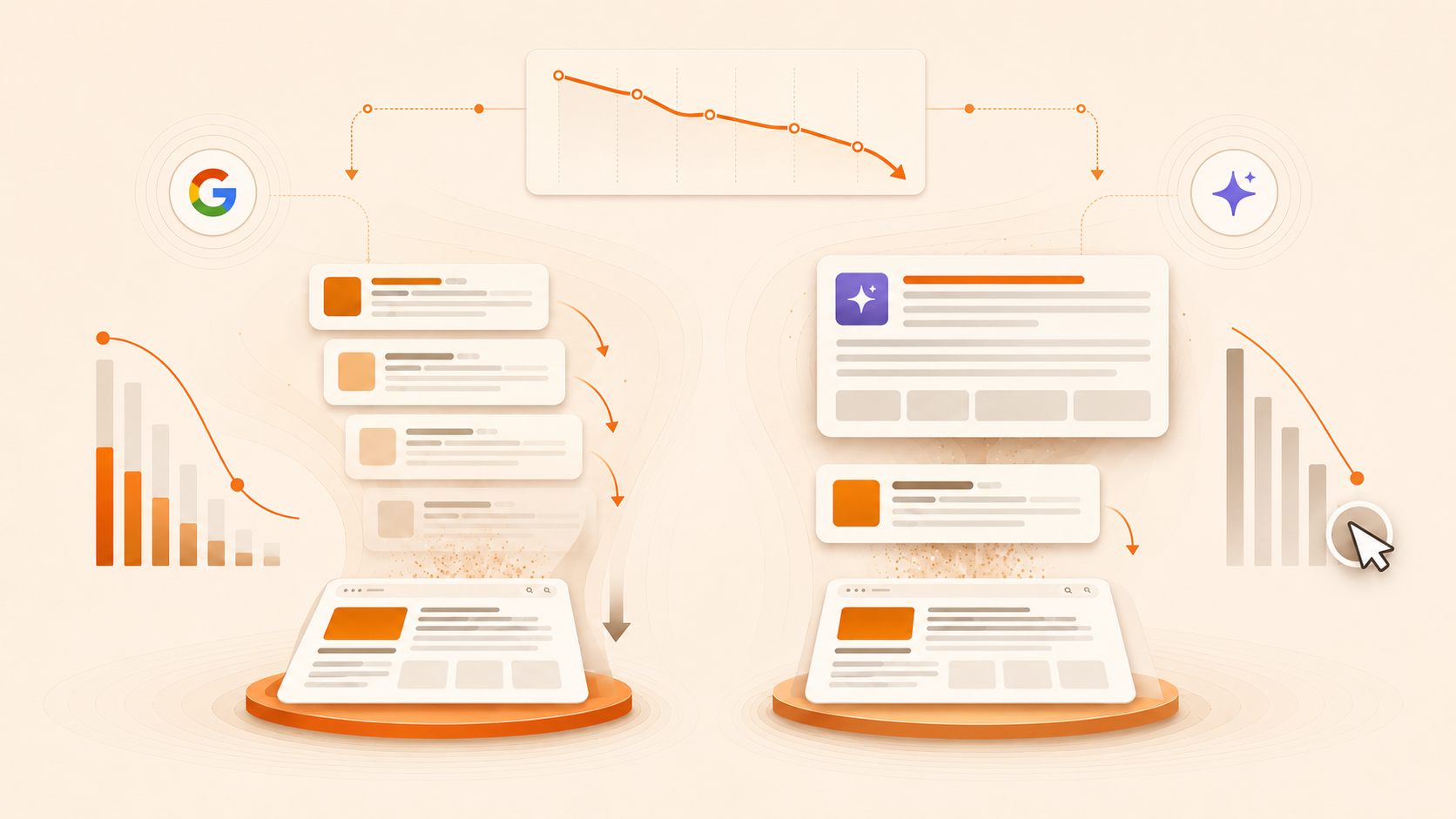
But the update didn't hit alone. Google I/O ran at almost the same time, and AI Overviews expanded significantly. That matters because it created two separate impacts that are showing up as one problem in most analytics dashboards.
- Impact one: Google is ranking your content differently based on quality signals.
- Impact two: Even if your rankings didn't move, the search results page itself changed. AI Overviews now sit above organic results for more queries than before. A page that ranks well can still lose 50-60% of its clicks because the query gets answered before the user reaches you.
Same traffic drop. Completely different causes. Completely different fixes.
That's what makes May 2026 harder to recover from than a typical core update, you're not just dealing with one algorithm change. You're dealing with the search results page being restructured around you at the same time. The rollout is expected to settle by early June, but the impact will stay long after that.
Google is not punishing AI content, but weak AI-written pages are at risk
One of the biggest misunderstandings around the May 2026 update is that Google is simply targeting AI-generated content.
That is too broad and wrong.
The real issue is not whether you used AI but whether the content you produced is useful, original, reviewed, and trustworthy. Thin content systems that depend on generic pages are seeing visibility drops.
AI-assisted content can still perform when it is shaped by human judgment. It can help with research, structure, outlines, first drafts, summaries, and formatting. But AI cannot replace real subject knowledge, sharp examples, product context, customer evidence, or editorial review.
The pages most at risk are easy to identify.
They usually have:
- Generic openings that could apply to any topic at any time.
- Rewritten versions of existing top-ranking articles.
- No expert quotes or real examples.
- No fresh data or first-party information.
- Repeated points under different subheaders.
- Programmatic page templates with very little difference between pages.
- No proof that the brand has any real connection to the topic.
- No clear answer near the top of each section.
This is why “AI content” is the wrong label. The better label is low-value content at scale.
A manually written page can also be weak if it repeats existing information. An AI-assisted page can be strong if it adds original examples, expert review, and clear structure.
Pages that answer better than competitors have a stronger chance of winning
The May 2026 update appears to reward pages that do more than match the query.
A page now needs to prove that it adds something useful to the topic. It should not simply repeat what every competitor has already said.
This is where the idea of “comparative usefulness” becomes important. The reference material describes Google’s shift from simple keyword matching to deeper semantic relevance, with stronger weight on subject-matter depth, examples, entity authority, and trust.
In simple terms, Google is comparing your page against the rest of the web.
For any topic, your page should answer these questions:
- Is this page clearer than the alternatives?
- Does it answer the user’s real intent?
- Does it include proof, examples, data, or expert input?
- Does it explain the topic from multiple useful angles?
- Does it help the reader make a decision?
- Can Google and AI systems extract the answer without confusion?
- Is the brand credible enough to speak on this topic?
This is a major change for content teams that still write for keyword coverage.
You cannot win only by adding the keyword in the title, H1, first paragraph, and meta description. You also need to show why your answer is better.
For example, an article on “AI discoverability” should not only define the term. It should explain how AI systems retrieve information, how query fan-out works, how citations are selected, what teams should measure, and what changes on the technical side.
Answer-first content formats are becoming more useful
The structure of content now matters almost as much as the substance.
AI systems often do not need your entire article. They may extract one section, one paragraph, one table, or one definition block. If the answer is buried under a long setup, the page becomes harder to use.
That is why answer-first formatting is becoming more useful.
A strong section should start with the answer, then add detail. It should not force the reader or AI system to work through five paragraphs before finding the point.
A better structure looks like this:
This format works because every section is easier to read and extract, and you’re saving on AI crawling and indexing costs.
The best-performing pages in this environment often use:
- Question-led headers.
- Short answer blocks.
- Clear definitions.
- Comparison tables.
- Step-by-step sections.
- Examples from real workflows.
- FAQs.
- Strong internal links.
- Schema where relevant.
- Source-backed claims.
This is also why broad content hubs and focused niche platforms can both win.
Large platforms like HubSpot often benefit from modular, answer-first content architecture. At the same time, smaller niche sites can win when they provide deeper topical coverage, stronger product knowledge, and sharper use-case detail.
What should you do after the May 2026 update?
Don't start fixing things before you know what broke.
The May 2026 update and the AI Overviews expansion landed at the same time. Your traffic drop could be coming from either or both. Acting before you know which one hit you is how teams waste months solving the wrong problem.
Wait until the rollout settles in early June before making firm conclusions. The better approach is to use the rollout window for diagnosis, technical checks, and page-level analysis.
Step 1: Separate the ranking problem from the click problem
A traffic drop doesn't mean your content failed. It might mean the search results page changed around you.
Rewriting content won't fix a CTR problem. Chasing SERP features won't fix a ranking drop. Know which problem you have first.
Step 2: Find out exactly what changed
Open Google Search Console and look at page-level and query-level data, make sure it’s not sitewide. Sitewide numbers hide everything.
Segment by page type: blogs, product pages, solution pages, comparison pages, documentation, glossary pages. Look at each group separately. If one template type dropped as a group, that's a structural problem.
Look specifically for pages with the biggest click drops, pages where impressions held but CTR collapsed, queries now triggering AI Overviews, and any crawl or indexation errors that appeared around May 21.
The pattern across pages tells you more than any individual page will.
Step 3: Find the weak content patterns
Once the data is segmented, the next step is pattern recognition.
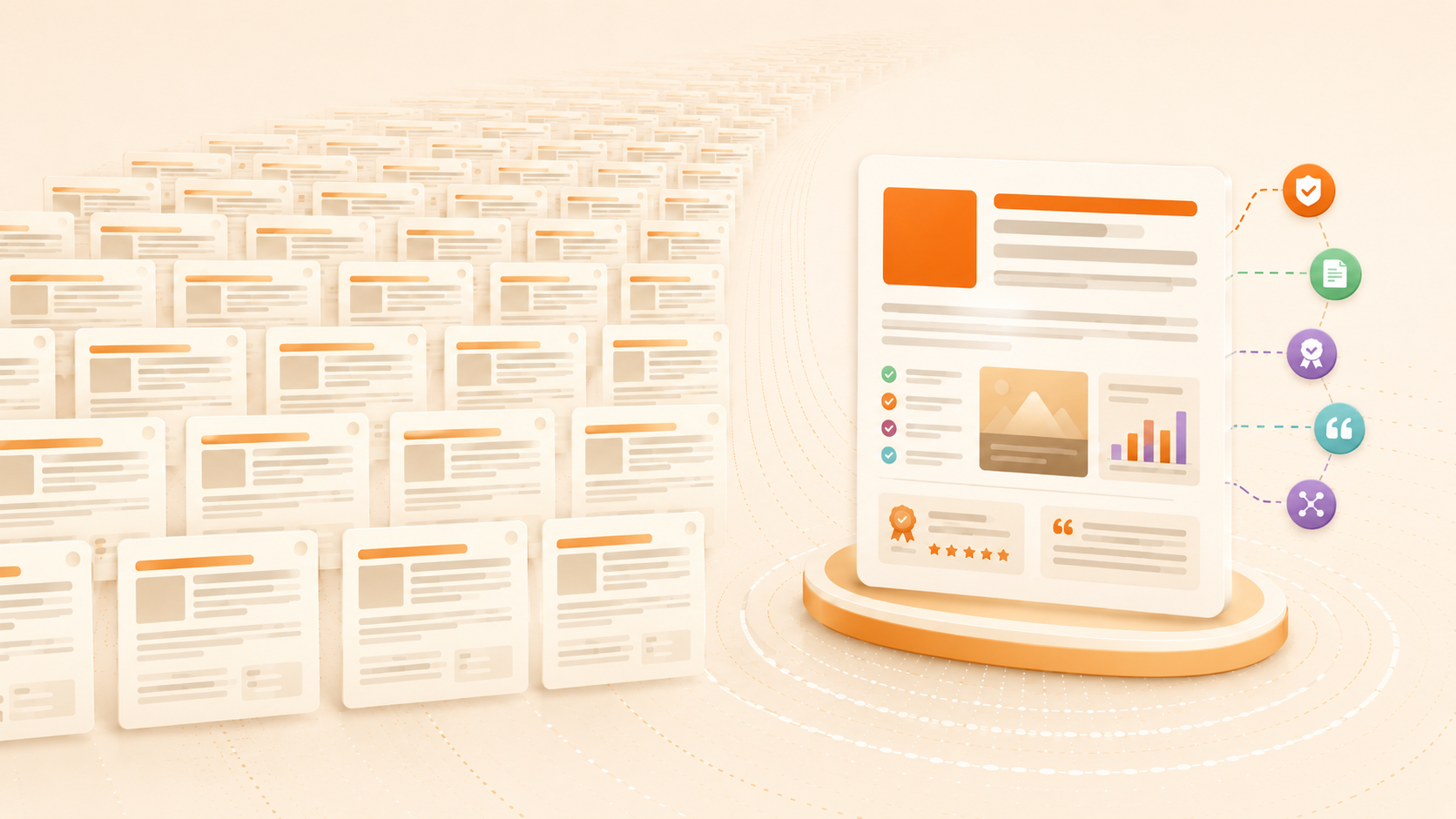
Core updates often expose repeated weaknesses across a site. For some websites, the issue may be thin AI-assisted content. For others, it may be shallow topic clusters, weak author credibility, poor internal linking, outdated examples, or programmatic pages that are too similar to one another.
Ask what your underperforming pages have in common. Common patterns worth finding:
- Articles that repeat what competitors already say with nothing original added
- Programmatic pages that are technically different but practically identical
- Glossary pages built purely for keyword capture with no real depth
- Old posts with outdated examples that haven't been touched in two years
- Pages covering topics your brand has no genuine authority in
- Content with no internal links connecting it to your product or proof pages
Some pages need rebuilding. Some need merging. Some need redirecting. Some need to be noindexed. Traffic alone shouldn't drive that decision, for example, a low-traffic page that supports a buyer journey is worth keeping. A page that adds nothing and connects to nothing isn't.
Step 4: Rebuild priority pages
After identifying weak patterns, start improving high-priority pages.
The priority should not be “update everything” but pages that matter for visibility, authority, and revenue. These may include high-intent guides, comparison pages, product-led articles, solution pages, integration pages, and documentation that supports buyer decisions.
A strong rebuild adds something the page was genuinely missing:
- A direct answer near the top of each section, i.e. don't make users hunt for the point
- Original examples from real customer work, not invented scenarios
- An expert quote or internal data point only your team has
- A comparison table that helps buyers decide, not just describes options
- FAQ sections built from real sales and support questions
- Stronger internal links to product and proof pages
For example, if a page explains “AI discoverability,” a weak update would only add more generic paragraphs. A stronger update would explain how AI systems retrieve information, how query fan-out works, which technical files matter, what metrics teams should track, and how brands can improve citation chances.
Step 5: Clean up the technical foundation
Once the biggest content issues are addressed, teams should turn to technical and AI-readiness work.
This does not mean chasing every new file, bot, or AI tactic. It means making sure your website is accessible, structured, and easy to interpret.
Start with the basics:
- Check robots.txt, nothing important should be accidentally blocked
- Confirm priority pages are in your sitemap and resolving cleanly
- Fix broken canonical tags, creating duplicate signals
- Improve internal linking; if key pages take five clicks to reach, crawlers deprioritise them
- Make sure important pages return 200 OK for bots
- Check that key pages aren't hidden behind JavaScript that crawlers can't render
- Add schema where it helps machines understand the page faster
- Set up GA4 tracking for AI assistant referrals
- Track AI assistant referrals in GA4 where available.
Next Steps After Google's May 2026 Core Update
Google isn't doing anything new. It's just getting better at identifying content that was always thin, always generic, and always built for rankings rather than readers.
If your traffic dropped, you have two questions to answer. Did your content lose ground, or did the search results page change around you? One is a content problem. The other is a visibility problem. They need different fixes.
The teams that recover fastest won't be the ones who react first. They'll be the ones who got honest about the quality of what they were publishing.
Frequently Asked Questions
Does Google penalize AI-generated content?
Google does not punish content only because AI was used during creation, but penalizes thin, repetitive, unedited, generic, or mass-produced content, whether it is AI-written or human-written.
The safer approach is to use AI as an assistant, not as a replacement for editorial judgment. Content should still include expert review, original examples, first-party data, clear sourcing, and real business context.
Why are organic clicks dropping even when rankings are stable?
Organic clicks can drop because the search results page has changed. A page may still rank well, but users may get their answer from an AI Overview, featured snippet, video result, forum result, or other SERP feature before clicking. This is why rankings and clicks need to be analyzed separately. If rankings are stable but CTR is falling, the issue may not be page quality. It may be SERP compression.
What kind of content performs better in AI search?
Content that performs better in AI search is usually clear, structured, original, and easy to verify. It answers the main question quickly, then supports the answer with examples, data, comparisons, or expert commentary.
What should brands do after the May 2026 Google Core Update?
Avoid rushed sitewide changes while the update is still being assessed. The better approach is to diagnose first, then fix what the data shows. Start by checking whether losses came from ranking drops, CTR drops, AI Overview compression, technical issues, or weak content patterns. Then prioritize pages that matter for visibility, authority, and revenue.
What should brands do after the May 2026 Google Core Update?
Brands should avoid rushed sitewide changes and first identify whether traffic loss came from ranking drops, lower CTR, AI Overview compression, technical issues, or weak content patterns. After that, they should improve priority pages with clearer answers, expert input, stronger examples, better internal links, and technical fixes that make the site easier to crawl and cite.