

Buyers are asking ChatGPT, Perplexity, Gemini, Claude, Copilot, and Google AI Overviews for answers before they visit a website. They ask for product recommendations, vendor comparisons, tool shortlists, pricing guidance, implementation advice, and alternatives. In many cases, the AI-generated answer becomes the first filter between your brand and the buyer.
At a basic level, AI visibility tells you how your brand appears inside AI-generated answers and helps you answer questions like
- Does AI mention our brand for relevant buyer prompts?
- Does it cite our website as a source?
- Which competitors appear more often than us?
- What topics does AI associate with our brand?
- Is the answer accurate, outdated, positive, or misleading?
- Which pages are being used as source material?
- What should we fix to improve our chances of being cited?
In this article, we will look at 10 AI visibility tools, what they track, how they usually track it, and how to choose the right tool for your business. This list is not based on one generic “best tool” score. We selected tools that represent different needs based on six criteria:-
We also looked for tools that help teams move from reporting to action. AI visibility tracking is useful only when it helps answer what to fix next.
So, let’s jump right into it and look at these tools one by one:-
1. Ahrefs Brand Radar
Ahrefs Brand Radar is Ahrefs’ AI visibility tool for tracking how brands appear across AI search surfaces. It is a strong fit for SEO teams that already use Ahrefs for keyword research, competitor analysis, backlinks, content research, and technical SEO.

The biggest advantage is that Brand Radar connects AI visibility with search behavior. Ahrefs says Brand Radar uses search-backed prompts, not only synthetic prompts, and lets teams analyze AI visibility across AI Overviews, AI Mode, ChatGPT, Copilot, Gemini, Perplexity, and Grok.
What Ahrefs Brand Radar tracks
Ahrefs Brand Radar helps teams track whether their brand, products, competitors, or domains appear inside AI answers. It also helps identify which sources are being used to support those answers.
It can be used to track:
- Brand mentions across AI platforms.
- AI citations and cited URLs.
- Cited domains and cited pages.
- Competitor visibility.
- Share of voice in AI search.
- Topics where a brand already appears.
- Gaps where competitors appear more often.
- Visibility across AI Overviews, AI Mode, ChatGPT, Copilot, Gemini, Perplexity, and Grok.
One useful part is citation analysis. Ahrefs has separate Cited Domains and Cited Pages reports that show the websites and pages mentioning or citing a brand in AI answers. Ahrefs notes that many AI citations may come from third-party websites, not only from the brand’s own domain.
How Ahrefs Brand Radar tracks AI visibility
Ahrefs’ main methodology advantage is its use of search-backed prompts. Instead of relying only on prompts created manually or generated artificially, Ahrefs says Brand Radar uses prompts derived from People Also Ask questions in its keyword database. This means the prompts are closer to what people already search for, rather than what a tool assumes people might ask.
The table below shows how Ahrefs turns search-backed prompts into brand, citation, and competitor data:-
Ahrefs Brand Radar is strongest when AI visibility needs to be connected with traditional SEO data. If your team already uses Ahrefs for keyword research, backlinks, competitor research, and content planning, Brand Radar can fit naturally into the same workflow.
2. Semrush AI Visibility Toolkit
Semrush AI Visibility Toolkit is built for teams that want AI visibility tracking inside a broader SEO workflow. That makes it different from tools that focus only on AI answer monitoring. If your team already uses Semrush for keyword research, site audits, competitor analysis, content planning, or reporting, the AI Visibility Toolkit can add a new reporting layer without forcing the team to move into a separate system.

Semrush describes AI visibility as how often a brand is mentioned, cited, or recommended in AI-generated responses across platforms such as ChatGPT, Perplexity, and Google AI Mode. It also makes an important point for SEO teams: ranking well in traditional search does not automatically mean you will be cited in AI-generated answers.
What Semrush AI Visibility Toolkit tracks
Semrush AI Visibility Toolkit covers the main parts of AI visibility reporting: brand presence, competitor performance, prompt opportunities, sentiment, and technical issues that may block AI crawlers. According to Semrush, the toolkit helps teams benchmark brand visibility, analyze competitors, monitor prompts, discover prompt topics, audit technical blockers, and create reports for AI-driven search.
It can be used to track:
- Brand mentions in AI-generated answers.
- AI visibility score.
- Competitor visibility.
- AI share of voice.
- Brand perception and sentiment.
- Prompt topics and opportunities.
- Daily visibility for selected prompts.
- Technical issues that may block AI crawlers.
- Regional AI visibility where available.
- Presentation-ready AI visibility reports.
The tool also includes prompt research and prompt tracking. Prompt Research helps teams find AI search topics to target, while Prompt Tracking lets them monitor visibility for selected prompts on platforms such as Google AI Mode and ChatGPT.
How Semrush tracks AI visibility
Semrush’s methodology is built around brand and prompt analysis. The tool first looks at a brand’s presence in AI-generated answers, then compares it with competitors and prompt opportunities. It also brings in sentiment and technical checks, which makes it more useful for teams that want to connect visibility with action.
Semrush connects brand monitoring, prompt research, competitor data, and technical checks through the following process:-
Semrush also defines AI share of voice as how visible a brand is in AI responses based on how often it is mentioned and how high it appears in answers compared with competitors. In the AI Visibility Toolkit, this appears inside the Brand Performance report.
3. Profound
Profound is an AI visibility platform built for brands that want to understand how they appear across answer engines. It is especially relevant for larger marketing teams because it covers multiple AI platforms and focuses on visibility, citations, and answer-level intelligence.
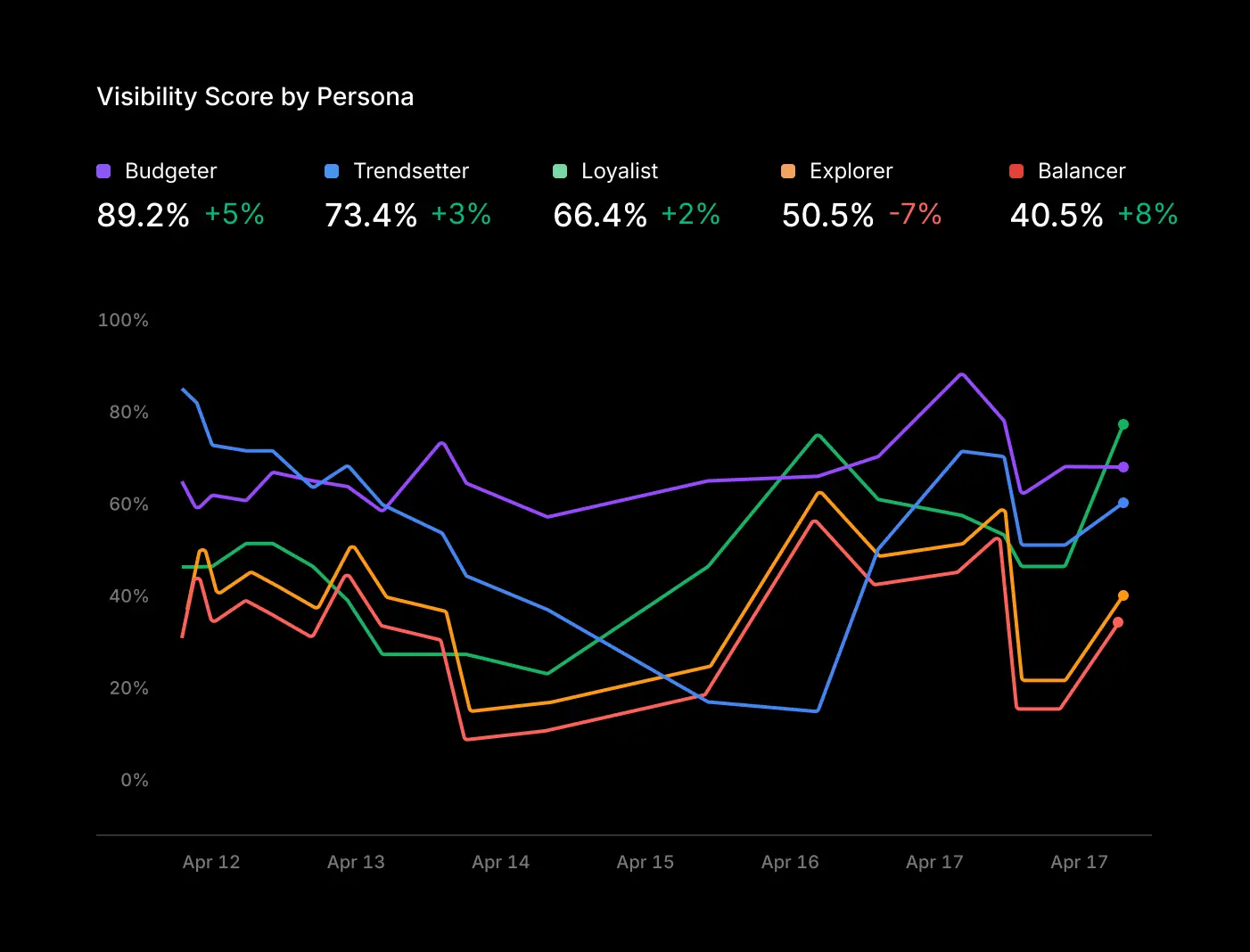
Profound claims that it helps brands get mentioned by Perplexity, ChatGPT, Claude, Gemini, Grok, Microsoft Copilot, Meta AI, DeepSeek, and Google AI Overviews. It positions itself around the “zero-click” shift, where users discover brands through AI-generated answers before visiting a website.
What Profound tracks
Profound tracks how AI systems mention and cite a brand across answer engines. Its Answer Engine Insights feature says teams can track AI visibility, analyze what AI systems say about a brand, and uncover which websites drive AI answers.
It can help track:
- Brand mentions in AI-generated answers.
- How often the brand appears across answer engines.
- What AI systems say about the brand and related topics.
- Citation sources that influence AI responses.
- Competitor presence in AI answers.
- Visibility trends across platforms.
- Content opportunities based on citation data.
The citation layer is important. If AI systems are answering questions about your category but citing competitors, review sites, or third-party publishers instead of your own site, that gives your team a clear direction. You may need stronger product pages, better comparison content, more third-party mentions, or clearer source-worthy content.
How Profound tracks AI visibility
Profound’s methodology is built around answer engine monitoring. In simple terms, it tracks how brands appear in AI-generated answers, analyzes the language of those answers, and identifies the sites that influence them.
Profound follows a monitoring and analysis process that connects AI answers with the sources shaping them:
Profound’s AEO guidance also recommends tracking where a brand appears across ChatGPT, Perplexity, Siri, and other answer engines, then using citation data to prioritize content improvements.
This is the key methodology point. Profound is not only tracking whether your brand appears; it also helps you understand which answer engines mention the brand, what they say, and which sources may be shaping those answers.
4. Peec AI
Peec AI is an AI search analytics platform built for marketing teams that want to track how their brand appears across AI systems. It focuses on visibility, prompts, citations, sentiment, competitor benchmarking, and reporting.
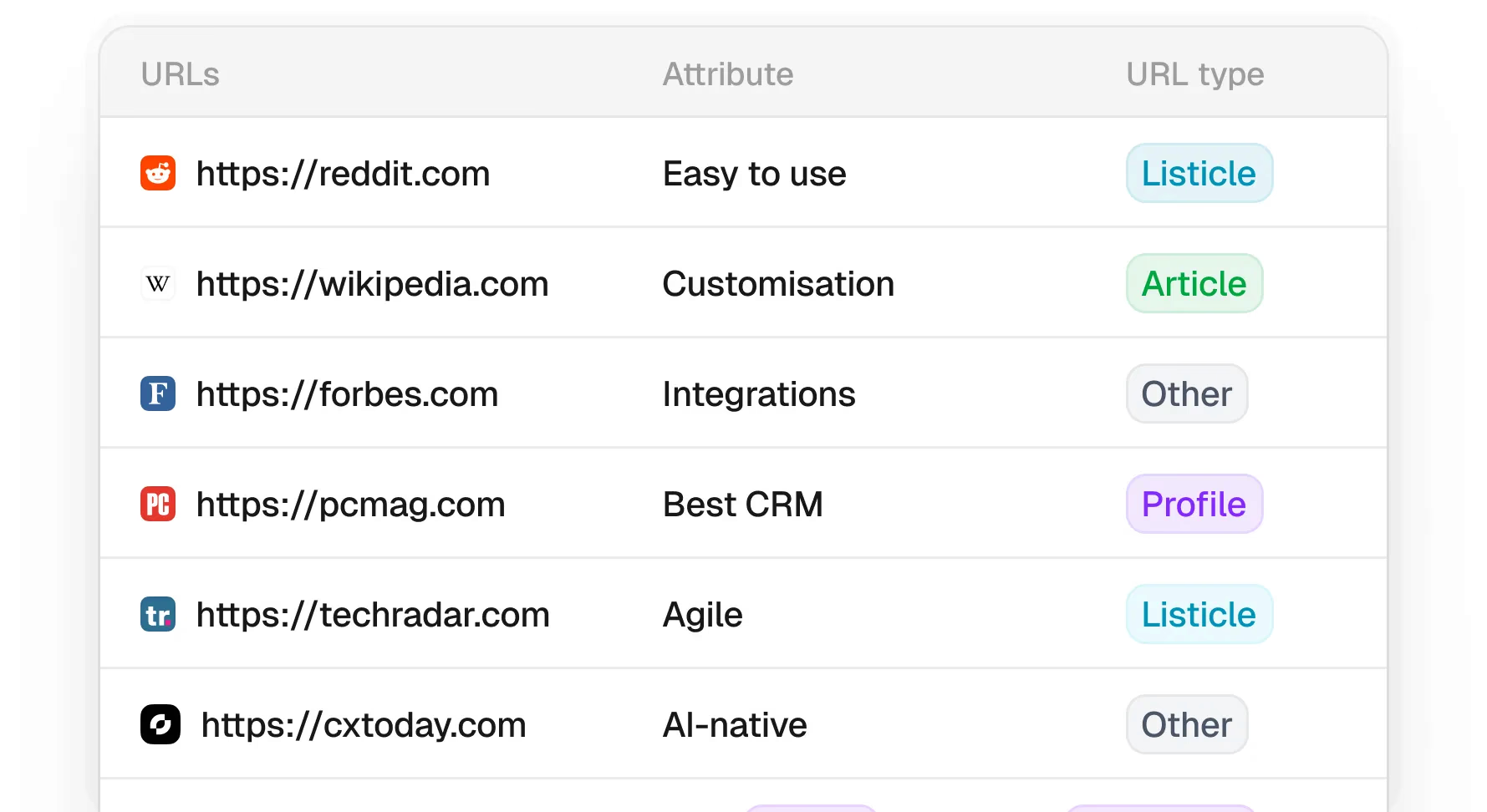
Peec AI says it helps teams analyze brand performance across ChatGPT, Perplexity, Gemini, and other AI systems. It also lets users add their own prompts, organize them with tags, track results across countries, and export data through CSV, Looker Studio, or API.
What Peec AI tracks
Peec AI tracks both brand visibility and source visibility. That distinction is important because your brand can be mentioned in an AI answer without your website being used as a source. Your website can also be used as a source even when the brand name is not directly mentioned.
Peec AI can be used to track:
- Brand mentions in AI answers.
- Source citations from your website.
- Visibility percentage.
- Sentiment.
- Average position in AI answers.
- Competitor visibility.
- Prompt-level performance.
- Country-level visibility.
- Model-level visibility.
- Prompt groups by persona, topic, funnel stage, or use case.
- Source usage at domain and URL level.
Its platform also supports reporting workflows through CSV exports, Looker Studio, and API access. That makes it easier for teams or agencies to include AI visibility data in recurring reports.
How Peec AI tracks AI visibility
Peec AI’s methodology is based on prompt tracking. Teams set up a workspace with their brand name and domain, then track prompts that reflect real customer questions. The platform runs those prompts across selected AI models and updates the data daily.
Peec AI moves from prompt setup to daily visibility reporting through the following steps:
Peec AI also separates “used” and “cited” source visibility. “Used” means the content informed the AI answer, while “cited” means the URL was explicitly shown as a source. This is useful because some AI systems may rely on content without always displaying a visible citation.
5. Otterly AI
Otterly AI is an AI search monitoring platform that helps teams track brand mentions, website citations, and competitor visibility across AI search engines. It is built for teams that want a practical way to monitor how their brand appears in AI-generated answers without setting up a large enterprise intelligence system.

Otterly AI says it tracks visibility across ChatGPT, Perplexity, Google AI Overviews, Google AI Mode, Gemini, and Microsoft Copilot. Its positioning is clear: AI search monitoring should help teams see which prompts they win, where competitors are cited, and what actions can improve brand presence.
What Otterly AI tracks
Otterly AI covers the core parts of AI search monitoring: mentions, citations, prompts, share of AI voice, and competitor visibility. It also includes features for GEO audits, brand reports, AI keyword research, query fan-out, AI referral traffic, and AI crawler simulation.
It can be used to track:
- Brand mentions across AI search platforms.
- Website citations in AI-generated answers.
- Share of AI voice against competitors.
- Prompt-level wins and losses.
- AI keyword and prompt opportunities.
- Query fan-out patterns.
- AI referral traffic.
- GEO content checks.
- AI crawler simulation.
- Brand reports across multiple workspaces.
The workspace feature is useful for agencies because each client or brand can have its own prompts, reports, audits, and team access. Otterly AI also mentions early-access API support and Agent Analytics for analyzing which AI crawlers engage with website content.
How Otterly AI tracks AI visibility
Otterly AI’s methodology is prompt-led. Teams define search prompts that mirror real user questions, and Otterly AI runs those prompts across multiple AI search platforms. It then checks which brands appear, which websites are cited, how often they show up, and what context surrounds the answer.
Otterly AI tracks each prompt across multiple platforms and turns the results into mention, citation, and competitor reports:
Otterly AI’s own feature guide says AI search analytics platforms should track how often, where, and why a brand appears across AI-generated answers, including prompt-level monitoring, citation attribution, competitor share of voice, entity tracking, sentiment framing, historical trends, content recommendations, and multi-engine coverage.
6. Scrunch AI
Scrunch AI is an AI search platform built around three connected needs: monitoring how your brand appears in AI answers, finding what is blocking visibility, and making your website easier for AI agents to read. This makes it different from tools that only track prompts and citations.

Scrunch positions itself as an AI customer experience platform. It says it helps teams monitor brand presence in AI search, analyze and optimize websites, and deliver content directly to AI agents through its Agent Experience Platform. It also says it is used by 500+ companies and agencies, including Lenovo, Skims, Crunchbase, and Penn State.
What Scrunch AI tracks
Scrunch tracks brand performance across AI platforms, but its product goes deeper into website accessibility and agent readiness. The platform covers monitoring, insights, optimization, and content delivery through its Agent Experience Platform.
It can help track:
- Brand presence in AI-generated answers.
- Prompt performance by topic, entity, persona, and location.
- AI citations and cited sources.
- Competitor visibility.
- Share of voice.
- AI bot traffic and crawl behavior.
- Technical errors that stop AI agents from accessing content.
- Content gaps around entities, claims, pricing, and product details.
- Pages that attract AI traffic or citations.
- Whether AI agents can parse important pages cleanly.
This makes Scrunch useful for both marketing and technical teams. The marketing team can see which prompts and competitors matter. The technical team can see whether AI bots are hitting errors, missing key pages, or struggling with content delivery.
How Scrunch AI tracks AI visibility
Scrunch measures AI visibility by collecting real AI responses and analyzing them for mentions, sentiment, citations, and competitor presence. Its FAQ says it measures brand presence by collecting actual responses across major AI platforms, not proxies.
Scrunch combines answer monitoring, bot activity, technical checks, and agent-ready content delivery in the following workflow:
The Agent Experience Platform is Scrunch’s standout feature. It creates a parallel, lightweight version of a site for AI agents, so the human website experience stays intact while agents receive cleaner, structured content. Scrunch says AXP is designed to improve crawl success, citations, and inclusion in AI answers.
7. AthenaHQ
AthenaHQ is an AI search visibility and GEO platform built for teams that want to track, compare, and improve how their brand appears across AI-generated answers. It is positioned more as a full AI search platform than a simple monitoring tool.
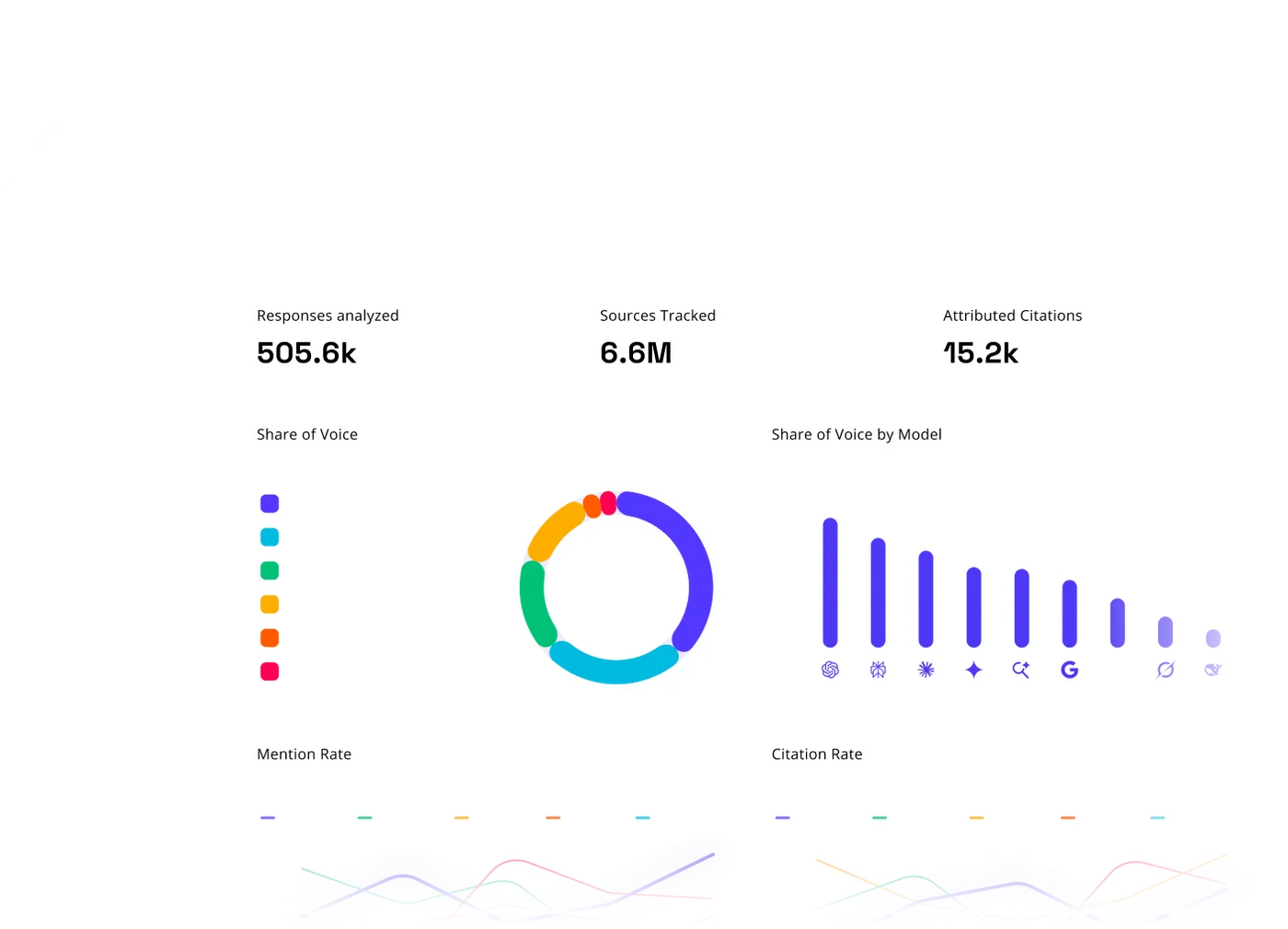
AthenaHQ says it tracks AI visibility across 8+ LLMs, including ChatGPT, Perplexity, Gemini, Google AI Mode, Google AI Overviews, Claude, Copilot, and Grok. It also highlights competitor tracking, benchmarking, prompt variations, conversation context, multi-language and multi-region support, and real-time brand sentiment intelligence.
What AthenaHQ tracks
AthenaHQ tracks brand visibility across AI platforms and gives teams a way to compare that visibility against competitors, categories, regions, and portfolios. Its portfolio visibility page shows multi-brand tracking, category share, and region-level performance views, which makes it especially relevant for larger teams or companies managing more than one brand.
It can be used to track:
- Brand mentions across AI platforms.
- Competitor visibility.
- Category share.
- Regional visibility.
- Multi-brand portfolio performance.
- Prompt-level visibility.
- Conversation context.
- Brand sentiment.
- AI search benchmarking.
- Visibility changes over time.
The portfolio use case is one of AthenaHQ’s stronger angles. Many AI visibility tools are built around one brand and one competitor set. AthenaHQ appears more useful when a company wants to track several brands, regions, or product lines from one dashboard.
How AthenaHQ tracks AI visibility
AthenaHQ’s methodology is built around cross-platform AI visibility tracking. Teams define the brand, competitors, topics, prompts, regions, and categories they want to track. AthenaHQ then monitors how those brands appear across AI engines and turns that data into visibility, sentiment, benchmarking, and category-share reporting.
AthenaHQ structures its tracking around brands, prompts, competitors, regions, and AI platforms, as shown below:
A third-party vendor profile describes AthenaHQ as an AI search visibility analytics platform with a strong methodology focus and an extensible query model, though that should be treated as supporting context rather than the main source.
8. Chosenly
Chosenly is a GEO software platform built specifically for B2B companies. Its core positioning is different from broad AI visibility tools because it focuses on buyer-stage prompts, not just general brand monitoring.

Chosenly says B2B buyers now use LLMs to shortlist vendors, and the platform helps companies see where they show up, fix misinformation, and win high-intent mentions that can drive pipeline.
What Chosenly tracks
Chosenly focuses on AI visibility in places where B2B buyers make decisions. Instead of only tracking broad category mentions, it is built around high-intent prompts that can influence vendor shortlists.
It can help teams track:
- Whether AI systems recommend the brand for buyer-stage prompts.
- Where competitors appear instead.
- Which prompts the brand wins or loses.
- Misinformation about the brand.
- Source gaps that affect AI recommendations.
- High-intent mentions that may influence pipeline.
- LLM visibility across buying journeys.
- Opportunities to improve answer presence through content and source placement.
This matters because B2B AI visibility is not only about awareness. A brand can appear for broad category prompts and still lose the buying journey if it does not appear for comparison, alternative, implementation, pricing, integration, or industry-specific prompts.
How Chosenly tracks AI visibility
Chosenly’s methodology appears to be built around high-value buyer questions. The platform tracks where a brand shows up across LLM searches, identifies misinformation, and helps teams act on prompts that matter for revenue.
Chosenly starts with buyer-stage questions and follows them through visibility tracking, misinformation checks, and source-gap analysis:
This buyer-prompt approach is useful because B2B search is not only informational. A buyer may ask AI to compare vendors, explain trade-offs, find alternatives, check integrations, or recommend tools for a specific company size and industry.
9. Siftly
Siftly is an AI brand monitoring and visibility platform that helps teams see how their brand appears across AI-generated answers. It also offers a free AI Visibility Checker, which makes it a good starting point for teams that want a quick snapshot before moving into ongoing monitoring.
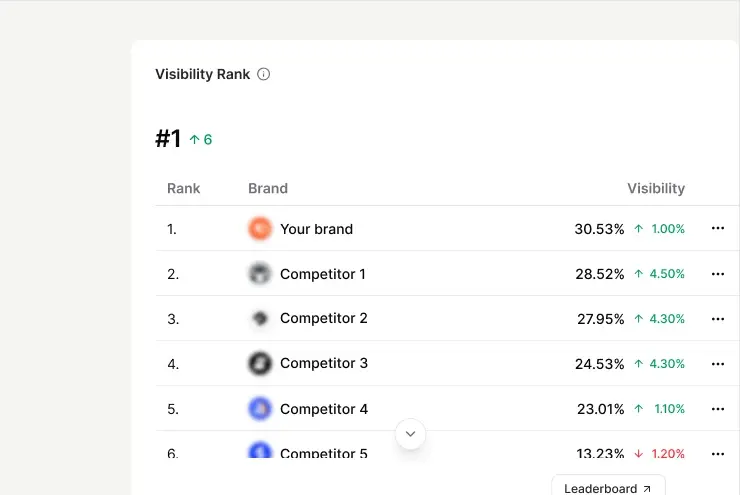
Siftly defines AI brand visibility as how often and how prominently AI engines name, describe, and recommend a brand when people ask questions in its category. It also says visibility is measured through mention rate, share of voice, sentiment, citation rate, and trend direction.
What Siftly tracks
Siftly tracks brand visibility across major AI engines, including ChatGPT, Claude, Perplexity, and Google AI Overviews. Its AI brand monitoring feature runs customer prompts daily and flags mentions, position, sentiment, hallucinations, and competitor co-occurrence in one dashboard.
It can be used to track:
- Brand mentions in AI answers.
- Share of voice against competitors.
- Sentiment around your brand.
- Citation rate.
- Prompt wins and losses.
- Competitor co-occurrence.
- Hallucinations or inaccurate claims.
- Visibility changes over time.
- Cited sources.
- Topic-level rankings.
The hallucination tracking feature is important. AI systems can sometimes misstate pricing, invent features, miss core positioning, or rely on outdated third-party content. Siftly says it compares AI responses against a structured profile of the real product and flags mismatches as hallucination alerts.
How Siftly tracks AI visibility
Siftly’s methodology is prompt-based. Teams define customer prompts that reflect how buyers ask questions, and Siftly runs those prompts across AI platforms on a set schedule. It then analyzes the answers for mentions, sentiment, positioning, and citations.
Siftly repeatedly tests customer prompts and reviews each response for brand position, sentiment, citations, and accuracy:
Siftly’s free checker uses a smaller sample of prompts and gives a one-time snapshot. Its paid platform tracks hundreds of prompts continuously, monitors changes over time, alerts on visibility drops, and updates competitor and topic-level rankings daily.
10. Rankscale
Rankscale is an AI visibility analytics platform built for teams that want broad engine coverage, regional tracking, citation analysis, and technical AI search checks. It positions itself around AI rank tracking and Generative Engine Optimization, rather than traditional SERP tracking alone.

Rankscale says it tracks brand visibility across 17+ AI engines, including ChatGPT, Perplexity, Claude, and Google Gemini. It also mentions tracking across 240+ countries and all languages, which makes it especially relevant for brands that operate across multiple markets.
What Rankscale tracks
Rankscale focuses on three core AI visibility surfaces: mentions, citations, and sentiment. It defines a mention as the brand appearing in the answer text, a citation as the brand’s URL being linked as a source, and sentiment as how the AI system positions the brand in the answer.
Rankscale can be used to track:
- Brand mentions across AI-generated answers.
- AI citations and source URLs.
- Sentiment around brand mentions.
- Competitor visibility.
- Share of voice.
- Citation domains.
- Regional and multilingual visibility.
- Technical checks related to AI discoverability.
- AI rank tracking across multiple engines.
Its technical audit layer is also worth noting. Rankscale says it includes 94+ technical checkpoints to audit structural and authority signals that AI engines may use to verify and cite content.
How Rankscale tracks AI visibility
Rankscale’s methodology is based on monitoring how AI systems answer prompts, then analyzing those answers for mentions, citations, sentiment, competitors, and source patterns. Its facts page describes the platform as measuring brand visibility in generated AI answers through systematic tracking across multiple LLMs and AI search systems.
Rankscale combines multi-engine prompt monitoring with citation, sentiment, competitor, and technical analysis through the following process:
This makes Rankscale useful for teams that want both answer-level tracking and technical AI search checks. It is not only asking, “Did we appear?” It is also helping teams assess whether their content and website are set up for better AI visibility.
How to choose the right AI visibility tool for your business
The right tool depends on what you want to measure, how mature your SEO program is, which AI platforms matter to your buyers, and whether your team needs reporting, diagnosis, or action planning.
Before choosing a tool, start with the business questions:
Are you trying to find out whether AI systems mention your brand? Are you trying to see why competitors are being cited? Are you trying to prove AI-led discovery is influencing the pipeline? Or are you trying to make your website easier for AI agents to crawl and understand?
The answer will guide your shortlist.
Step 1: Start with the AI platforms your buyers actually use
Start by asking where your buyers are likely to ask questions.
If your buyers depend heavily on Google Search, make sure the tool tracks Google AI Overviews and AI Mode. If they use research-heavy AI tools, ChatGPT, Perplexity, Claude, and Gemini may matter more. If your buyers work inside enterprise systems, Copilot and ChatGPT Enterprise may be more relevant. If your brand operates globally, country and language tracking become important.
Step 2: Look closely at the prompt methodology
Some tools use search-backed prompts. Some let you add custom prompts. Some focus on buyer-intent prompts. Some run prompts repeatedly to reduce answer variation. Some group prompts by funnel stage, country, industry, product, persona, or competitor.
This matters because AI answers can change between runs. A weak prompt set can make your visibility look better or worse than it really is.
Before choosing a tool, ask whether it can track the questions your buyers actually ask. For example, “best CRM for healthcare” is useful, but a real buyer may ask, “Which CRM should a mid-market healthcare company use if it needs Salesforce integration and patient communication workflows?”
The second prompt is more specific. It also tells you much more about buying intent.
A good tool should support custom prompts, competitor prompts, alternative prompts, industry prompts, and use-case prompts. It should also help you track prompt-level wins and losses over time.
Step 3: Decide whether you need reporting, diagnosis, or action planning
If your team only needs to know whether your brand appears in AI answers, a lighter monitoring tool may be enough. If AI search is becoming part of your acquisition strategy, choose a tool that helps you decide what to fix next.
For example, a reporting-focused tool may show that your competitor appears more often for “best tools for healthcare messaging.” A more action-led tool may show that the competitor is being cited because it has stronger integration pages, clearer comparison content, more third-party mentions, or better documentation.
That second layer is where AI visibility becomes useful for content, SEO, product marketing, and PR teams.
Step 4: Match the tool to your team type
Different teams need different workflows.
A mid-market marketing team may want focused prompt tracking, competitor visibility, sentiment, and citations without a heavy setup. Peec AI, Otterly AI, and Siftly may work better here.
A B2B SaaS team may care more about buyer-stage prompts than broad brand monitoring. Chosenly is stronger for that use case because it focuses on high-intent prompts and vendor shortlisting.
An enterprise brand may need broader reporting across regions, categories, brands, and AI platforms. Profound, Scrunch AI, AthenaHQ, and Rankscale are better suited for those needs.
The tool should fit how your team works, not the other way around.
Step 5: Check whether the tool tracks citations, not just mentions
A strong tool should show which pages from your site are cited, which competitor pages are cited, which third-party domains influence answers, and which prompts generate citations.
This helps your team move from visibility tracking to content improvement.
For example, if AI tools keep citing competitor integration pages, you may need stronger integration content. If they cite review sites or listicles, you may need better third-party presence. If they cite your old blog posts, you may need to refresh them before AI systems keep repeating outdated information.
Step 6: Look for competitor and source-level reporting
A tool should not only show whether your brand appears. It should show who appears instead, where they appear, and what sources support their visibility.
Useful competitor reporting should answer questions like:
- Which competitors appear most often?
- Which prompts do they win?
- Which AI platforms favor them?
- Which URLs or third-party sources support their visibility?
- Are they being recommended, cited, or only mentioned?
- What topics are they associated with?
This is where AI visibility becomes useful for strategy. You are not only tracking brand presence. You are learning how AI systems understand your market.
Step 7: Do not ignore sentiment and hallucination tracking
AI systems could end up describing your product incorrectly, miss important features, repeat outdated positioning, or compare you unfairly with competitors. They may also cite old third-party sources that no longer reflect your product.
A tool should be able to track sentiment and hallucinations. This is especially useful if your product changes often, your pricing has changed, your category is competitive, or your brand has security, compliance, or regulatory claims. In those cases, an incorrect AI answer can create confusion before a buyer ever reaches your website.
Step 8: Choose a tool that fits your reporting process
Before buying, check how the tool fits into your reporting workflow. Can reports be exported? Does it support dashboards, CSV exports, API access, or Looker Studio? Can prompts be grouped by client, brand, region, funnel stage, or product? Can multiple team members work inside the tool? Does it support alerts? Can you compare visibility over time?
The buying decision should not stop at features. It should include usability, reporting fit, team adoption, and how clearly the tool helps you decide the next action.
Before you finalize a tool, ask these questions:
- Which AI platforms does it track?
- Does it support custom prompts?
- Does it use search-backed prompts, buyer-intent prompts, or both?
- Does it track mentions and citations separately?
- Does it show competitor visibility?
- Does it identify cited URLs and source domains?
- Does it track sentiment or hallucinations?
- Does it show trends over time?
- Does it suggest actions or only report data?
- Does it fit your existing reporting workflow?
- Does the pricing make sense for your stage?
AI visibility tools are still changing fast, so your first tool does not need to be perfect. But it should help your team answer three questions clearly:
- Where does our brand appear in AI answers?
- Why are competitors being mentioned or cited instead of us?
- What should we fix next to become a more trusted source?
Frequently Asked Questions
What is an AI visibility tool?
An AI visibility tool helps you track how your brand appears inside AI-generated answers. It shows whether platforms like ChatGPT, Perplexity, Gemini, Claude, Copilot, Google AI Overviews, and AI Mode mention your brand, cite your website, recommend your product, or show competitors instead.
How is AI visibility different from SEO visibility?
SEO visibility usually tracks rankings, impressions, clicks, backlinks, and organic traffic. AI visibility tracks brand mentions, citations, sentiment, prompt performance, competitor presence, and share of voice inside AI-generated answers. Both are connected, but they measure different parts of the discovery journey.
What should AI visibility tools track?
A good AI visibility tool should track brand mentions, citations, share of voice, competitor visibility, prompt-level performance, cited URLs, sentiment, hallucinations, and changes over time. The best tools also show why competitors are being cited and what your team should fix next.
Do AI visibility tools replace Ahrefs, Semrush, or other SEO tools?
No. AI visibility tools do not replace traditional SEO tools. You still need keyword research, technical audits, backlink analysis, content planning, and rank tracking. AI visibility tools add another layer by showing how your brand appears in AI-led discovery.
How often should teams track AI visibility?
Teams should track AI visibility at least monthly. Fast-moving categories may need weekly tracking. AI answers can change based on new content, competitor activity, third-party mentions, model updates, and search behavior. Regular tracking helps teams spot visibility drops, citation changes, and prompt gaps early.
Can AI visibility tools show why competitors are winning?
Some tools can. The better tools show which competitors appear more often, which prompts they win, which pages or third-party sources are cited, and what content gaps may be helping them. This helps teams move from reporting to action.
What is the most important metric in AI visibility tracking?
There is no single metric that explains everything. Mention rate shows whether AI systems know your brand. Citation rate shows whether your content is used as a source. Share of voice shows how you compare with competitors. Sentiment shows whether AI systems describe your brand correctly. Together, these metrics give a better picture than one score alone.